
Why I Built Postmello
Friendship deserves room to grow, before texting and social media.
 By Patrick Amihood, Creator of Postmello ·
Last summer, my older daughter, 9 years old, asked my wife to borrow our phone to text a best friend.
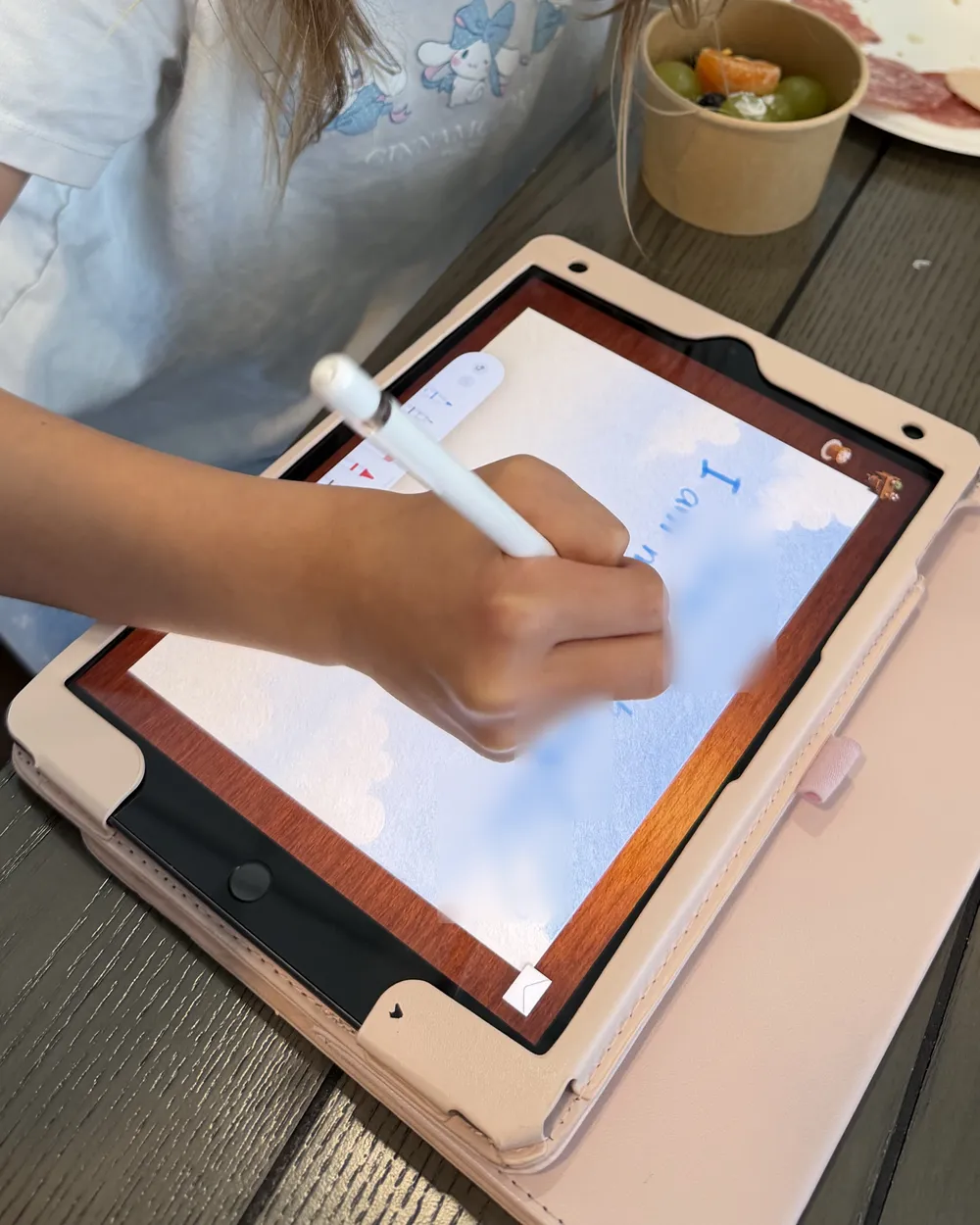
It was a small request, and a reasonable one. School was out. My daughter missed a friend and wanted a way to stay in touch without asking us to arrange every exchange. That wish for a little independence was something I wanted to encourage.
I have spent my career in Silicon Valley building technology, and I know how much a device's design shapes the way we use it. What gave me pause was how much seemed to come bundled with the answer. Borrowing our phones meant stepping into a text conversation. A phone of my daughter's own would make that conversation available throughout the day, alongside everything else a personal device brings.
I wanted another way to say yes.
Friendship during the waiting years
The decision about a first smartphone is often discussed as a question of timing. How long should we wait? What changes when school friends start getting phones? How do we hold a boundary without making someone feel left out?
Organizations such as Wait Until 8th help people navigate that decision together. Its pledge concerns delaying a smartphone until at least the end of eighth grade; it explicitly leaves room for communication through simpler devices.
That distinction matters to me. What I wanted to postpone was not a screen. It was texting and social media: the conversation that never closes, the audience, the pull to answer right away. Wanting to wait does not make the need for friendship disappear. A friend moves away. School ends for the summer. Someone wants to share a drawing, remember a joke, or tell a person about the day.
My daughter's request made the gap very concrete. Saying “you'll see each other when school starts” would have left the actual wish unanswered. I wanted a way for those friendships to have a life between visits.
Postmello grew from that question: what would digital correspondence look like if it began with making a letter for someone you know?
A reason to sit down and make something
Letters offered a useful starting point. A page gives you room to decide what to say and how to say it. Words can sit beside a drawing. A short note can occupy a whole sheet. Choosing paper, an envelope and a stamp gives the act a beginning and a finish.
There is a pleasure in it I remember from the old days: the postal ritual, then the wait for the flag to go up when a reply comes back. Opening a letter someone made just for you never gets old.
Digital delivery removes the days in transit while keeping that opportunity to make something. The other person receives the page as it was composed, rather than a succession of messages appearing in a stream.
That difference became central to Postmello. I wanted the experience on the screen to be worth the time spent there: writing, drawing, arranging, thinking about a friend. There is no requirement to produce an impressive letter. A ridiculous picture and a few words belong just as much as a careful account of a whole week.
A tablet or a phone gives that activity somewhere to happen. It can be a shared device at home, with a separate desk for each person, or a parent's phone, lent for a letter instead of a text. Someone comes to the desk to write or check the mailbox, then puts the device down. Where and when that happens remains a decision for the people using it. At my daughters' ages, that decision is still mine.
Opening a letter does not send a read receipt, and nobody sees whether someone is online or halfway through a reply. A letter can arrive quickly and still wait patiently. We built three kinds of quiet around that idea.
Independence inside known relationships
I also wanted my daughters to be able to write without us composing every message or operating the app for every exchange.
In Postmello, admins approve the friends who exchange letters. There are no public profiles to browse, no audience to build and no stranger discovery. That is what makes me comfortable as a parent: it is a small circle, closed on purpose. Nothing public, no photo or video sharing, no forwarded memes. Those decisions give the person at the desk room to act independently within relationships already agreed upon.
Inside that boundary, the space is personal. A nameplate, a nickname, a hero icon and a chosen desk help make it feel like somewhere that belongs to its writer. The familiar name stays visible beneath a different sender nickname, so expression still has a recognizable person behind it.
This should have room to grow. A younger writer might mainly draw. An older writer might fill pages, invent a comic, or send a short note that would make sense to only one friend. Adults have desks too. The point is to offer a form of correspondence with its own appeal through those changes, including for people who already have phones.
The people worth writing to will not all use the same software. That is why email correspondence matters: an approved friend can answer from an inbox, and those words arrive at the desk as a letter. Joining Postmello later preserves the relationship and its letters.
Then the letters started moving
I built the first version over the summer, and my older daughter and that best friend began exchanging letters almost every other day. Before long there were letters to school friends too.
We spent months abroad that summer, and people we knew were traveling too. The letters kept moving even when the writers were in different countries. We also met people whose friendships began during a few days together and continued through Postmello after everyone went home.
Those experiences made the purpose much clearer than my original idea had been. The valuable part was the continuity: someone had a way to reach a particular friend, independently, after the shared afternoon or holiday was over.
Across roughly a hundred builds, my two daughters, friends and other early users helped shape how that worked. I watched which interactions made sense and which ones needed another attempt. People took to choosing their spaces and stationery, and those choices became part of the pleasure of writing.
The letters themselves remained wonderfully varied: drawings, jokes, stickers, brief messages and longer ones. My younger daughter, who is six, mostly sends rainbows. The medium left room for all of them.
What I want to make room for
Postmello began with my older daughter's request, but the question has grown with the product. How much independence can a digital space offer while staying quiet, personal and bounded? How can it make creation inviting and leaving easy? How can people keep writing to one another as circumstances and devices change?
I want Postmello to make those possibilities ordinary. A person sits down at a desk, makes something for a friend, sends it, and gets on with the day. There is a sense of connection without anxiety, and of anticipation without the constant pull to check.
I hope that this can help children retain their childhood for a little longer: postponing texting and social media, and protecting three kinds of quiet.
The next letter will be there when it is time to return.
Postmello is available now for iPhone and iPad on the App Store.