

Three Kinds of Quiet
Time to make something. Time to answer. A small circle.
 By Patrick Amihood, Creator of Postmello ·
In the opening of The Name of the Wind, Patrick Rothfuss describes a silence with three parts. That idea has stayed with me: a place might be quiet in several ways at once, and each kind of quiet might mean something different.
While making Postmello, I kept returning to a similar question. What would make a digital writing space feel quiet?
Turning down the sound would only answer a small part of it. A silent screen can still be full of demands. A message can make no noise and still leave you feeling that somebody is waiting for an answer.
The quiet I wanted had to reach further: into the time spent making a letter, the expectations between friends, and the question of who else is listening.
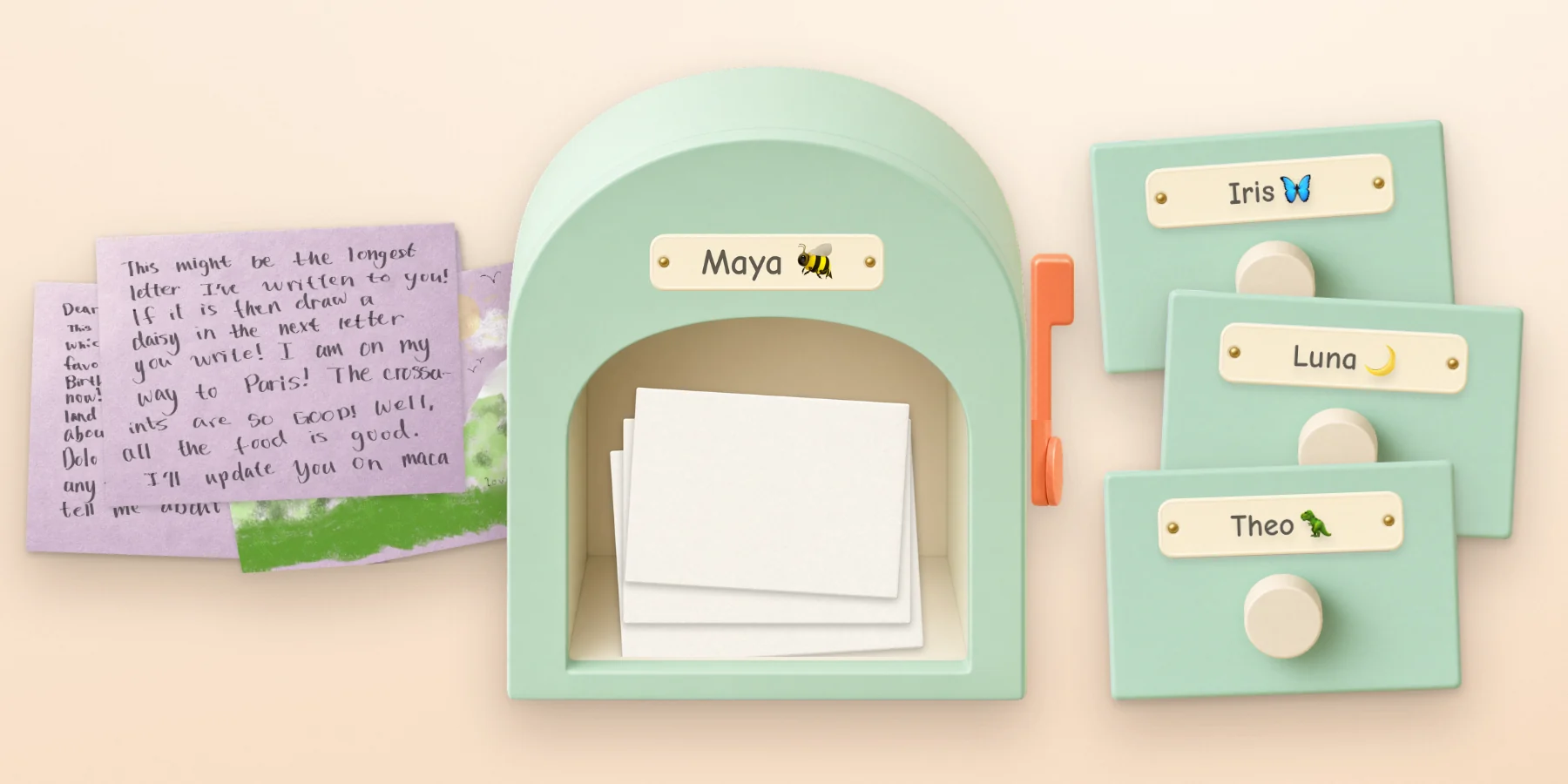
The first kind is the quiet of being absorbed in something.
A page is open. There is room to write, draw, add a sticker, reconsider a sentence, or leave a little space. Another letter arriving should not break that concentration.
Postmello's new-mail sound belongs to the mailbox flag. It plays when the flag rises on the desk, where there is an object to explain the sound. It also greets someone arriving at a desk with mail waiting. It stays quiet during writing and reading, and returning from the background to the same desk does not set it off again.
There are other sounds: paper moving, a drawer opening, a stamp peeling, the small sounds of the courier bee. Most answer something the person at the desk just did. They give the objects a little weight. There is no soundtrack asking to share attention with the page.
The postal ritual belongs to this quiet too. Choosing paper, making the letter, dressing the envelope, attaching the address and adding a stamp create a rhythm. Each act has a place, and sending has a finish: when the letter is posted, the visit is complete, with no feed waiting underneath it.
I wanted to keep that rhythm. A letter does not have to be long or serious to deserve it. Three words and a drawing still become something someone made for a friend.
The second kind is the quiet of having time to answer.
Opening a letter in Postmello sends no read receipt to the writer. There is no indicator showing who is online, and no moving dots revealing that someone has begun a reply.
Those small signals carry a surprising amount of social information. They tell us that someone is present, that a message has been seen, that an answer might be about to arrive. They make the other person's time visible.
I wanted to leave that time with its owner. A person should be able to read, think, get distracted, go outside, or begin a reply and finish it later. The letter remains there through all of that.
Nor is there a streak to keep alive, or a number counting up what arrived while someone was away. A letter that comes while the device is put away waits in the mailbox, the way mail waits on the doormat, until someone is ready to open it.
Digital delivery is still quick. Two friends might exchange letters in an afternoon. But a quick delivery does not need to become a demand for a quick reply.
The third kind is the quiet of a small circle.
A lot of what makes a screen loud has nothing to do with sound. It is the sense of being watched, measured or reached by people you do not know. A post has an audience. A group chat fills with things forwarded from somewhere else. A profile can be found.
A Postmello desk has none of that. Nothing is public, and there are no likes, followers or feeds. Only friends an admin has approved can write, and there is no way to search for a desk. A letter keeps its audience: it cannot be forwarded, and a reply goes only to the people who were on the letter. There is no way to attach a photo or a video, and an email reply arrives as words alone, with its links removed.
What is left is small on purpose: a few people, known by name, writing to one another. A letter can be silly or careful, private or shared with a few friends, without anyone else looking on.
That is the space I wanted the postal ritual to hold open: time to make something, time to receive it, a small circle to share it with, and permission for the rest of life to happen in between.
Literary reference: Patrick Rothfuss, [The Name of the Wind, prologue](https://www.penguinrandomhouse.ca/books/297978/the-name-of-the-wind-10th-anniversary-deluxe-edition-by-patrick-rothfuss/9780756413712/excerpt).