
A Friend Does Not Need Another App
The correspondence continues across devices and inboxes.
 By Patrick Amihood, Creator of Postmello ·
A letter should be able to reach a friend who does not have the app.
That sounds like a small accommodation. Add an email address, send a copy, and the problem seems solved. But correspondence has two directions. And a friendship lasts longer than the choice of app someone happens to use today.
The more we worked on email in Postmello, the more those two facts shaped the design.
An admin adds the friend's address and chooses which desks write to that friend. A letter sent from one of those desks arrives by email as an envelope and a private link to the pages. The friend sees the letter as it was made, with its paper, writing and decoration together.
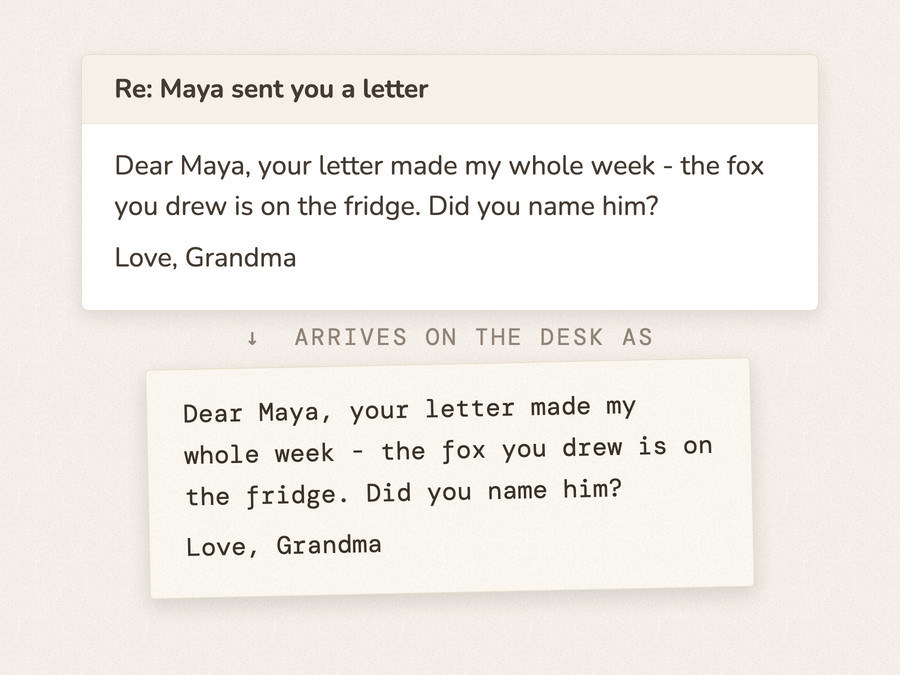
The friend can write back from the inbox. The words are set onto paper and arrive in Postmello as a letter. There is also an address for that particular correspondence, so an approved friend can begin a letter without waiting for another one to arrive first.
At the desk, the relationship has the same familiar form: a name, a drawer, letters sent and letters received. Someone does not have to learn a second kind of friendship because the person at the other end uses email.
There are boundaries around what crosses that bridge. Email replies carry words onto the page; attachments and active links do not become content on the desk. The sender is checked against the approved address. Mail that needs an admin's judgment is held away from the desk until that review happens.
Then comes the question that made the feature substantially more complicated: what happens if the friend joins Postmello?
I did not want joining to split one relationship into a before and an after. Old letters should not be marooned in an email history, while a newly created friend begins with an empty drawer.
So the friend already has a place for those letters inside Postmello. It exists before anyone sits down at that desk. Joining gives someone access to the correspondence already there.
That still leaves a harder problem. Several people may have been writing to the same friend, under different names. One desk knows Carol as Grandma. Another knows Carol as Aunt Carol. Meanwhile, Carol and Sam might share a single inbox.
Matching email addresses cannot tell us which of those names belong together. If the software simply merged everything delivered to one address, it would combine two people's correspondence. If it kept every introduction separate forever, one person could end up with several desks for the same relationships.
Postmello therefore asks for the human decision. The invitations identify the names and the desks writing to them. The person accepting selects the entries that belong together, then gives them a desk of their own or brings them into a desk that already exists. An unrelated name can stay unselected.
There is another route for someone who joins using a different email address: the admin who knows the friend can identify that existing email correspondence when connecting the Postmello desk. That decision concerns the correspondence the admin already manages. It does not declare that every similar name or address elsewhere is the same person.
Underneath that choice, the merge has to be careful. Existing letters and friendships follow the person. Nicknames remain with the desks that chose them. Old envelopes keep their original labels. Correspondence addresses already shared must still lead to the right place, including addresses used to answer in either direction. A block must stay a block.
Even the state of an old letter matters. Something already opened through its email link should be filed with the kept letters after joining, rather than presented as a fresh arrival all over again.
None of that should feel like a migration project to the friend accepting an invitation. The visible result should be ordinary: the letters are here, the people are familiar, and the correspondence continues.
Email also remains useful after someone has a desk. An inbox may be the convenient place to answer while away from the desk. Supporting that route makes participation less dependent on everyone using the same device in the same way.
That is the inclusion I wanted email to provide. The invitation is to stay in touch. The software should make room for the way a friend is able to answer.