
A Space of Your Own
How a practical edge became a place with a view.
 By Patrick Amihood, Creator of Postmello ·
Postmello began with one desk.
At first, I was trying to make that desk work: give the paper somewhere to sit, make the mailbox feel like a mailbox, and find a sensible home for the drawers. The scene needed to hold together before there was much reason to imagine another one.
Then there were several desks. Changing the materials and objects gave each a different character. Choosing where to write became part of using Postmello.
I remember the Japanese desk as an important point in that progression. A different wood, a different mailbox and a different treatment of the drawers suggested more than a new set of colors. The objects started to imply a place around them.
Meanwhile, I was working on a very practical problem: the back of the desk.
A screen does not offer one fixed rectangle. Different sizes and proportions have to hold the same writing space. The rim helped contain that space, while the lower surface could stretch to fit. It was a useful way to make the desk feel complete across devices.
But the rim also raised another question. What belonged beyond the writing surface?
Until then, I had mostly been thinking about how to close the scene. A back edge gave it a boundary. Looking at that boundary differently suggested a more playful possibility: it could be the edge of a space with a view.
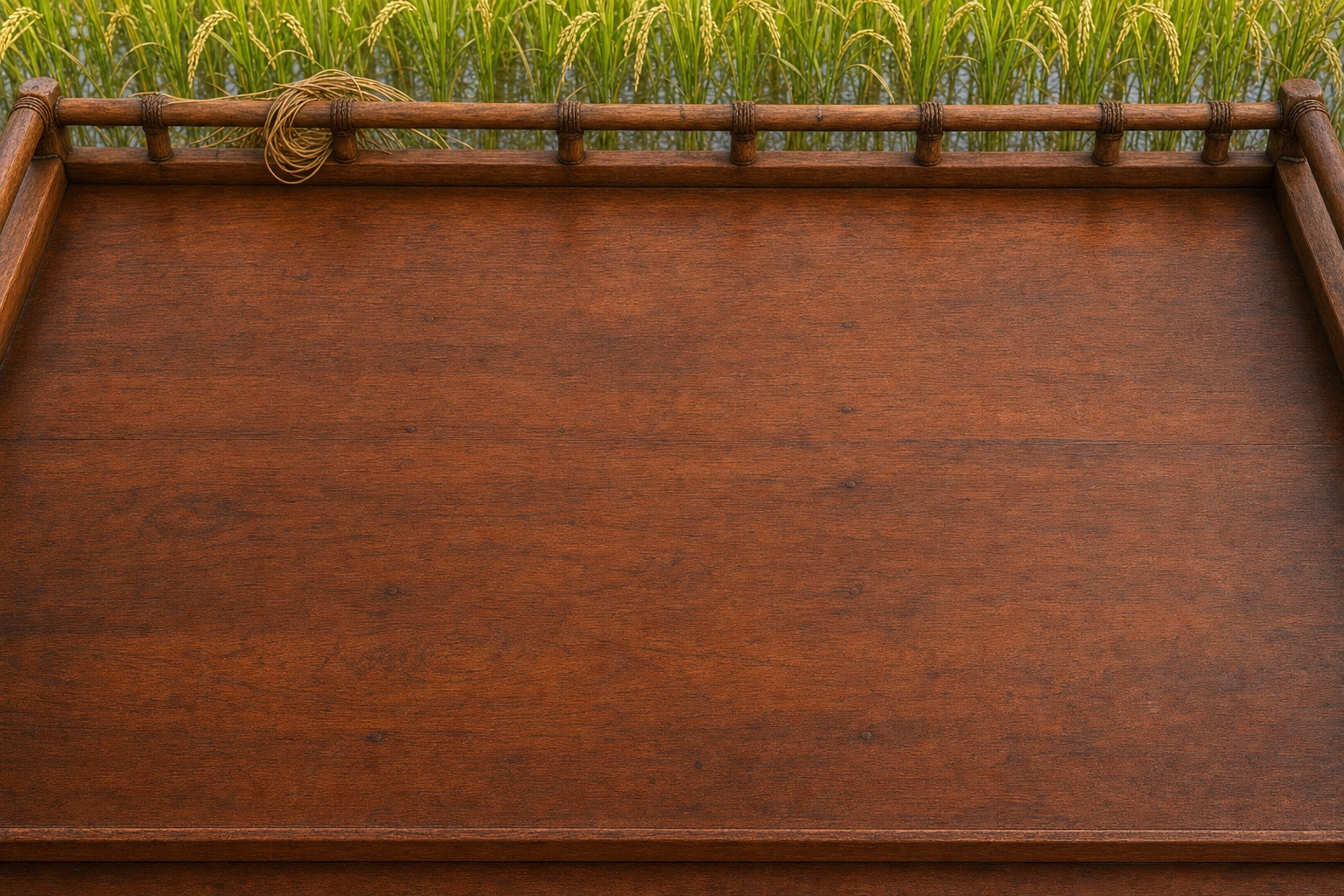
The desk could sit somewhere.
That changed what I was designing. The working surface still had to be calm and usable, but the surrounding scene could carry a little distance, atmosphere and imagination. The place beyond the paper became part of what made a desk feel like its own world.
There was a balance to find. More scenery is not automatically a better writing space. A beautiful background that crowds the paper, obscures a drawer or makes the mailbox hard to recognize gets in the way of the reason to be there.
The familiar objects therefore keep their responsibilities. Whatever the setting, the mailbox receives, the paper starts a letter, and the drawers hold correspondence. Moving to a different space should leave enough familiarity to settle in and begin.
I have enjoyed seeing people extend those choices into the rest of their desk: a name, an icon, paper and decoration that feel at home together. The writing space becomes personal before the letter itself begins.
That was not something I planned in full when there was only one desk. It emerged while solving smaller problems, including how a piece of furniture should fit different screens.
A practical edge became an invitation to imagine what was on the other side. Once I saw that possibility, making another desk meant choosing another place to write from.